


Christmas Tree Season in the Pacific Northwest: Why Shippers Should Book Early and Plan Ahead
Christmas tree shipping tightens Pacific Northwest truckload capacity in late November 2026. See the peak weeks and how early to book trucks.

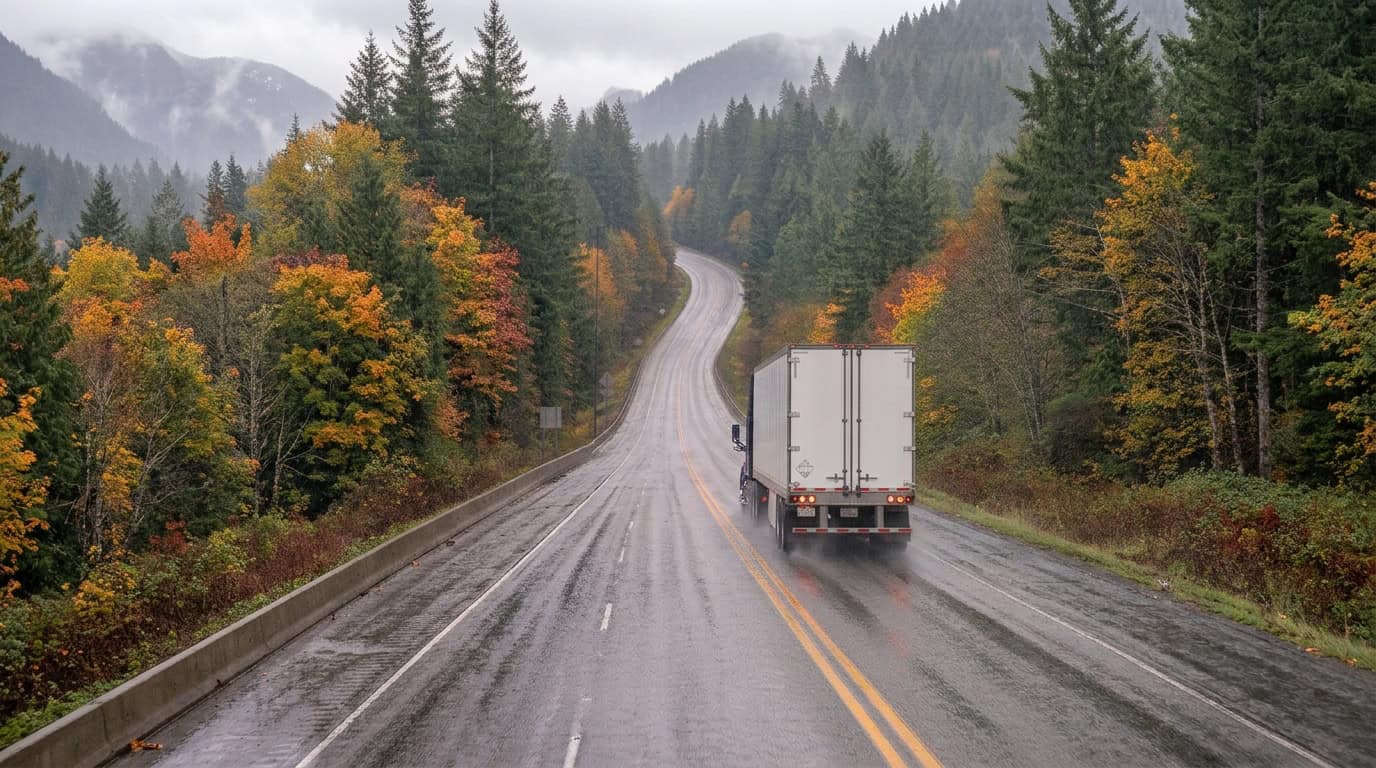
Key takeaways
- Pacific Northwest truckload capacity tightens most in the 7 to 10 days before Thanksgiving, which in 2026 falls on November 16 to 19, according to DAT’s analysis of the Christmas tree harvest.
- Spot rates can rise as much as 20% in the three weeks before Thanksgiving as tree shippers compete for dry vans and reefers, per DAT.
- The 2026 season starts from an elevated base: Pacific Northwest reefer spot rates averaged $3.07 per mile for the week ending October 3, 2026, up 46.2% year over year (DAT).
- Multi-stop Christmas tree loads can keep a truck under load for four to six days, so each tree load removes more capacity than a single shipment suggests.
- Book early and plan ahead: tender peak-week loads well in advance and secure recurring Pacific Northwest lanes before Thanksgiving.
Every November, one of the easiest regions in the country to find a truck becomes one of the hardest. Christmas tree growers in Oregon and Washington have roughly a month to move their harvest, and they compete for the same dry vans and reefers that every other Pacific Northwest shipper needs.
If you ship truckload freight out of Portland, Seattle, or the Willamette Valley, you will feel it even if you have never shipped a tree. The timing is predictable, so shippers who book early and plan capacity ahead can avoid most of the cost and service risk.
Why does Christmas tree season tighten Pacific Northwest truckload capacity?
Christmas tree season tightens Pacific Northwest truckload capacity because a short, fixed harvest window creates a surge of outbound loads in a region that normally ships little freight. Growers must move freshly cut trees within days, so they bid aggressively for trucks, and those trucks then stay committed to long, multi-stop deliveries.
- Volume in a small window. Oregon growers sold 3.171 million Christmas trees in 2023, worth $117.6 million, according to the USDA National Agricultural Statistics Service. About 92% of Oregon’s trees ship out of the region, according to Pacific Northwest Christmas Tree Association figures cited by DAT, and on peak days the region dispatches more than 60 tree loads a day, per DAT.
- A low-volume market. The Pacific Northwest usually has more trucks than outbound freight, so when demand spikes there is little spare capacity to absorb it.
- Trucks tied up for days. Tree loads often deliver to several retail lots and farm stands. Multi-drop tree loads can keep a truck under load for four to six days, according to DAT, removing that truck from the market for most of a week.
- Produce overlap. The harvest overlaps the tail of fall produce season for potatoes, onions, apples, and pears, adding competition for reefers.
When will capacity be tightest in 2026?
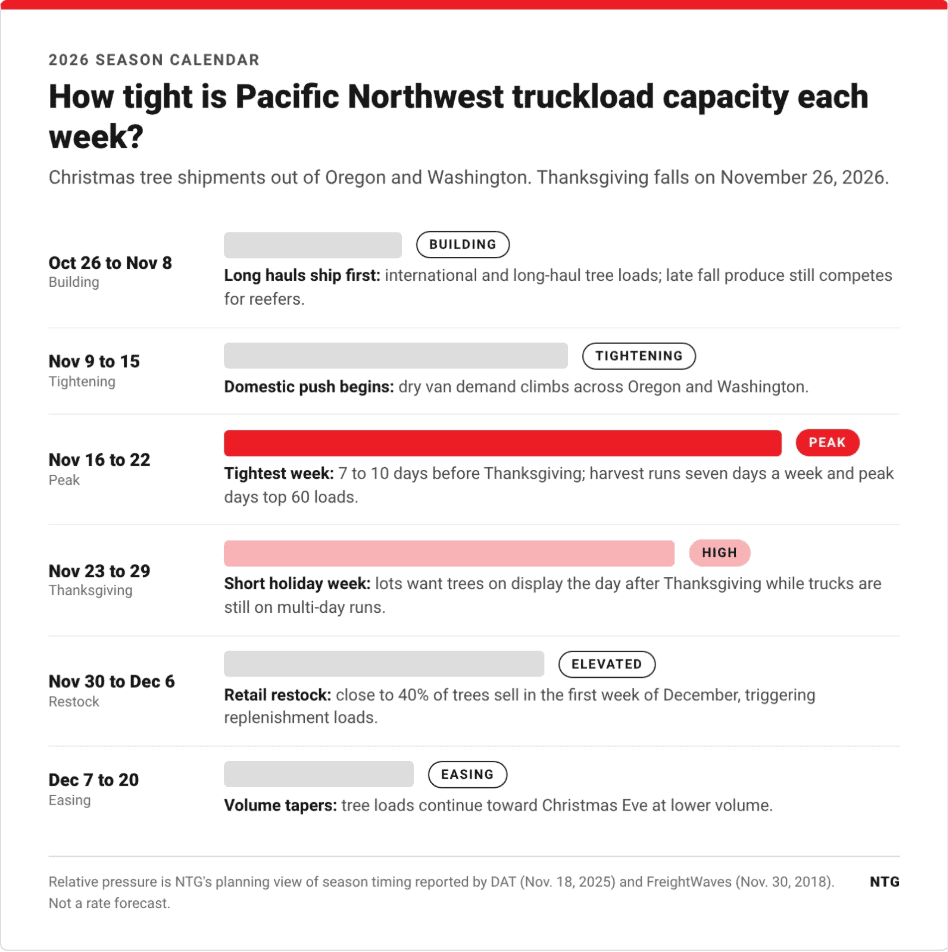
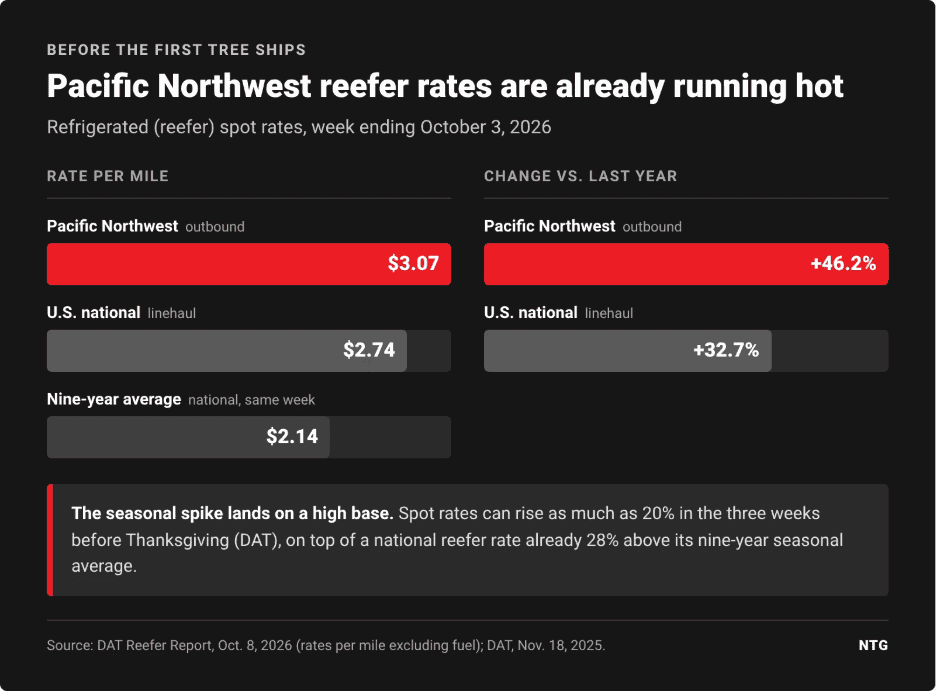
Pacific Northwest capacity in 2026 should be tightest during the week of November 16, the 7 to 10 days before Thanksgiving on November 26. DAT reports that the main domestic tree push begins in early to mid-November, intensifies in the days before Thanksgiving, and runs seven days a week at peak. Spot rates can climb as much as 20% across the three weeks leading into the holiday, and shippers should expect fewer available trucks and longer lead times to secure one.
Pressure does not end on Thanksgiving. Retail lots restock heavily after opening weekend, and retailers sell close to 40% of their trees in the first week of December, according to FreightWaves. The calendar below shows what to expect each week.
Planning freight for the peak week? Get a truckload quote from NTG before carriers fill their schedules.
Why is this year’s starting point already higher?
The 2026 tree season is starting from a refrigerated market that was already tight before the first trees shipped. DAT data shows Pacific Northwest reefer spot rates averaged $3.07 per mile for the week ending October 3, 2026, up 46.2% from a year earlier, while the national reefer linehaul average of $2.74 per mile ran 28% above its nine-year seasonal average (DAT).
The pressure has continued into November. As of November 4, 2026, reefer tender rejection rates had moved above both their Labor Day and July 4 peaks, with harvest activity in Idaho and Oregon tightening the Pacific Northwest, FreightWaves reported. Dry van tender rejections were near 11%, still a tight market. A tender rejection is a carrier declining an offered load, which pushes more freight to the spot market.
Which shippers and equipment feel it most?
Christmas tree season puts the most pressure on dry van and reefer freight leaving Oregon and Washington, including food and beverage, packaging, building materials, and retail distribution loads.
| Equipment | Pressure | Why |
| Dry van | High | Growers compete heavily for dry vans for regional tree loads (DAT) |
| Reefer (refrigerated) | High | Reefers handle the longest tree hauls and overlap with late fall produce |
| Flatbed | Moderate | Some tree loads move on flatbeds (DAT) |
| Rail and intermodal | Relief valve | Growers use rail piggyback trailers to reach large markets such as Los Angeles and San Diego when trucks run short (DAT) |
Most Christmas tree loads move on short-term rate agreements because the season is so brief, FreightWaves notes. That means tree shippers bid directly against your spot freight, and carriers can choose the higher-paying tree load over your tender.
How can shippers book early and plan capacity ahead this season?
Early booking and proactive capacity planning are the main levers shippers control during Christmas tree season. Tendering earlier than usual, avoiding the peak week where possible, and securing coverage before Thanksgiving all reduce exposure to peak spot pricing and rejected tenders. NTG recommends the following practical guidance:
- Tender as early as your orders allow. Give carriers more lead time than your usual standard, especially for loads picking up November 16 to 25.
- Pull freight forward or push it back. Moving a load from the week of November 16 to the week of November 9, or to after December 7, often avoids the steepest spot pricing.
- Widen pickup and delivery windows. Flexible appointments make your load easier for a carrier to fit around multi-day tree runs.
- Lock in contract coverage on recurring lanes. Steady weekly volume out of the Pacific Northwest is better protected by committed capacity than by the spot market during peak. Our peak season preparation guide covers how to set this up.
- Consider intermodal for long hauls. For non-urgent freight to Southern California or other large markets, intermodal rail can relieve pressure when trucks are scarce.
NTG’s temperature-controlled team works with refrigerated carriers year round, which helps shippers line up reefer capacity before the peak week rather than during it. The guide below shows suggested lead times by pickup week and trailer type.

When does Pacific Northwest capacity loosen?
Christmas tree demand on Pacific Northwest capacity typically eases after the first week of December, once retail restocking slows. Christmas tree loads continue moving until around Christmas Eve, but at lower volume than the pre-Thanksgiving peak, according to FreightWaves.
National capacity usually stays firm through the holiday weeks as drivers take time off, so freight shipping between Christmas and New Year’s still benefits from early booking. Our guide to avoiding holiday shipping delays covers cutoff dates and contingency planning. With 2026 rates already elevated, shippers should not expect the Pacific Northwest to return to its usual low-cost profile until the new year.
Need help covering a Pacific Northwest load this season? Request a quote from NTG and an NTG expert will help you find capacity before the peak, or quote, book, and track Full Truckload and LTL freight yourself in Beon Shipper.
Frequently asked questions
When is Christmas tree shipping season?
Christmas tree shipping season in the Pacific Northwest runs from late October through late December. The longest international and long-haul loads ship first, and volume is heaviest in the weeks before Thanksgiving, according to DAT.
Where do Oregon’s Christmas trees ship?
California is the largest market for Oregon’s Christmas trees at about 45%, followed by Mexico at about 16%, according to Pacific Northwest Christmas Tree Association figures cited by DAT. Most of the rest go to other western and southwestern states, plus some international markets.
Which states produce the most Christmas trees?
Oregon, North Carolina, and Michigan produce the majority of fresh-cut Christmas trees shipped across the U.S., according to FreightWaves. Pacific Northwest farms mainly supply markets west of the Mississippi River, so the November capacity squeeze described here is concentrated on western lanes.
Angela Duesterhaus is Vice President, Sales at NTG Freight, where she leads the Sales Enablement team. Since joining NTG over two years ago, she has drawn on more than 20 years of logistics industry experience to help sales teams build stronger relationships and win new business.
More Blogs





On this page:
Subscribe to our Newsletter