



Standard Pallet Size: Everything to Know About Shipping Pallets
The U.S. standard pallet is 48 x 40 inches. See other common sizes and how many pallets fit in a 53 ft trailer, box truck or shipping container.

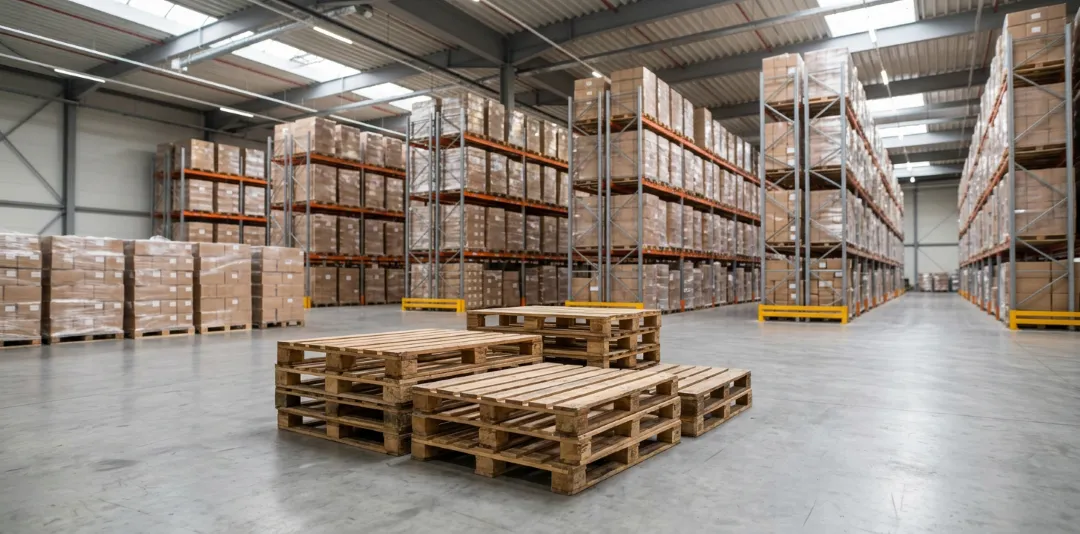
What is a standard pallet size? Considering the size and scope of the freight and shipping industry, this information is not as well known or as easy to find as one would hope. There is a standard, though.
Quick answers:
- Standard U.S. pallet size: 48″ x 40″ (1,219 x 1,016 mm), known as the GMA pallet.
- Floor space per pallet: 1,920 square inches, or about 13.33 square feet.
- Pallets in a 53 ft dry van: 26 to 30 on the floor, depending on the loading pattern.
- Double-stacked in a 53 ft dry van: up to 52, if the freight is stackable.
What is the average pallet size?
The standard footprint is known as the GMA pallet, after the Grocery Manufacturers Association, which set its specification; the association became the Consumer Brands Association in January 2020. It remains the most produced pallet in the U.S., at 29% of new pallets made in 2021, according to a peer-reviewed study of the U.S. pallet market (BioResources, 2025).
A GMA-spec pallet stands about 6.5 inches tall (manufacturer GMA specification), though other designs run shorter, so measure your own pallets.
Though there is a standard pallet size in the industry, that doesn’t mean that there are not multitudes of varying shipping pallet sizes that are used daily.
The second most common shipping pallet size (outside of the standard pallet size) is 48″ x 48″. Sometimes this can also be considered a “standard” pallet, and its presence is common in many global warehouses.
What other pallet sizes are common?
Industries and regions outside U.S. grocery often standardize on their own footprints. Automotive suppliers, beverage distributors and European or Asian exporters each tend to ship on a different size, which changes how many pallets fit on a truck.
| Pallet size (inches) | Metric (mm) | Where it is common |
| 42 x 42 | 1,067 x 1,067 | Paint, telecom |
| 48 x 45 | 1,219 x 1,143 | Automotive |
| 48 x 42 | 1,219 x 1,067 | Beverage, chemical |
| 36 x 36 | 914 x 914 | Beverage |
| 48 x 20 | 1,219 x 508 | Retail displays |
| 47.24 x 31.50 | 1,200 x 800 | Europe (EUR pallet) |
| 47.24 x 39.37 | 1,200 x 1,000 | Europe, Asia |
| 43.30 x 43.30 | 1,100 x 1,100 | Asia |
Sources: industry uses from Conner Industries; metric footprints recognized in ISO 6780, the international pallet dimension standard, which also includes the 48 x 40.
What is the difference between stringer and block pallets?
A stringer pallet is built on long boards, called stringers, that run its full length, while a block pallet sits on solid blocks between the top and bottom decks. The design decides which sides a forklift can enter from, and that decides whether the pallet can be turned sideways in a trailer.
- 2-way entry: unnotched stringer pallets accept forks from the two ends only, so they can only be loaded straight.
- 4-way entry: block pallets, and stringer pallets with notches cut into the sides (the GMA design), accept forks from every side, which makes turned and pinwheel loading possible.
Block pallets are also generally stronger and spread weight more evenly across the deck than stringer pallets, which makes them the usual choice for heavy industrial goods and for loads that will be double-stacked.
How many pallets fit in a truck?
Truck capacity depends on three things: trailer length, pallet footprint and loading pattern. Getting the count wrong has a direct cost: freight that does not fit means a second truck or a rebooked load.
In Less-than-Truckload (LTL) shipping, standardizing your footprint is critical, as carriers optimize their trailer floors to fit two 48-inch pallets side by side. Trailers measure roughly 100 to 101 inches wide inside, depending on wall construction (Utility Trailer), so slightly larger pallets, up to 48″ x 48″, can also be loaded side by side.
In truckload shipping, you often use standard 53 foot dry vans, or in some instances, 48 foot vans.
Three ways to load a 53 ft trailer
| Loading pattern | How pallets sit | Math | 48 x 40 pallets |
| Straight | 40-inch side across the trailer, two per row | 13 rows x 48 in = 624 in of floor | 26 |
| Pinwheel | One pallet straight and one turned in each row | Interlocking rows use the leftover width | 28 |
| Turned | 48-inch side across the trailer, two per row | 15 rows x 40 in = 600 in of floor | 30 |
Two turned pallets span 96 inches, leaving only a few inches of side clearance for freight that overhangs the pallet.
Unfortunately, not many shippers or receivers have the forklifts capable of handling pinwheeling, so it’s safer to plan on a straight load. If you’re using a smaller, 48′ truck, you can fit 24 pallets loaded straight, and 48 double.
Weight and height limits
A trailer can run out of weight before it runs out of floor. Federal rules cap the gross vehicle weight of a truck on the Interstate System at 80,000 pounds, a limit that includes the tractor and trailer as well as the freight (23 CFR 658.17). After the tractor and trailer are counted, a typical 53 ft dry van can legally scale 42,000 to 45,000 pounds of freight.
- Weigh-out: dense freight, such as metals, liquids or paper, reaches the weight limit before the floor is full.
- Cube-out: light, bulky freight fills the trailer before it reaches the weight limit.
A second layer only works when the bottom layer can bear the weight and both layers clear the roughly 110 inches of inside height (Utility Trailer). In practice, that means each stacked pallet, including the pallet itself, stays under about 55 inches.
Pallet capacity for other trucks and containers
| Equipment | Inside dimensions | Loaded straight | Best turned or mixed layout |
| 53 ft reefer | 97.5 in wide, 104 in high | 26 | 28 to 30, only with tight side clearance |
| 45 ft high-cube container | 44 ft 5 in x 7 ft 8.6 in | 22 | 24 mixed |
| 40 ft container | 39 ft 5 in x 7 ft 8.5 in | 18 | 20 mixed |
| 20 ft container | 19 ft 4 in x 7 ft 8.6 in | 8 | 9 mixed |
| 26 ft box truck | 25 ft 11 in x 8 ft 1 in | 12 | 14 turned, no overhang |
| 24 ft truck | 24 ft of usable floor | 12 | 12 |
| 16 ft box truck | 16 ft x 7 ft 7 in | 8 | 8 |
Counts assume 48 x 40 pallets with no overhang. “Mixed” places one pallet turned and one straight in each row, for equipment too narrow to fit two turned pallets. Sources: Utility Trailer reefer specifications (reefer counts assume at least 52 ft of floor behind the refrigeration unit); Hapag-Lloyd container specifications for 45 ft, 40 ft and 20 ft; Penske Truck Rental for box trucks, whose interiors vary by body builder.
Keep these numbers on the dock: download the printable dock loading cheat sheet, a one-page reference with both capacity tables and the loading-pattern math for your warehouse team.
How to calculate capacity for non-standard pallets
For any other pallet size or piece of equipment, four steps give a reliable floor count.
- Measure the loaded pallet at its outermost points, including overhang. NTG’s guide to avoiding LTL reweigh and reclassification charges shows how carriers take these measurements.
- Divide the inside width by the pallet width, rounding down, to get pallets per row.
- Divide the inside length by the pallet length, rounding down, to get rows, then multiply. Repeat with the pallet turned and keep the higher count.
- Check height and weight against the ceiling, the door opening and the legal payload before planning a second layer.
Example: 36 x 36 beverage pallets in a 26 ft box truck fit 2 across (72 of 97 inches) and 8 rows deep (288 of 311 inches), for 16 floor positions.
How pallet size affects LTL cost
In LTL, pallet dimensions carry a direct price. A pallet’s length, width, height and weight set the shipment’s density, and density is a primary driver of its National Motor Freight Classification (NMFC) class, as NTG’s guide to freight class explains. Freight that overhangs the pallet inflates the measured cubic dimensions, which lowers the calculated density and can push the shipment into a higher class, directly increasing its LTL cost.
Pallet count also points to the right mode. Smaller shipments move as LTL with FreightPros powered by NTG, in-between shipments fit volume LTL or partial truckload, and loads near a full trailer belong in Full Truckload.
What are pallets made of, and where can I find them?
Wood and plastic dominate shipping pallets, and each suits a different supply chain.
- Wood: the low-cost, high-capacity default for most U.S. freight. A standard 48 x 40 wood pallet is typically rated for about 4,600 pounds or more at rest (static) and roughly 2,200 to 3,000 pounds while moving on a forklift (dynamic), and damaged boards can be repaired (Gruber Pallets).
- Plastic: higher upfront cost, but easy to wash and sanitize and consistent in weight and size, which is why pharmaceutical and food-grade supply chains prefer it. Because ISPM 15 regulates only wood packaging, plastic pallets are exempt from its treatment rules for export.
- Pallet pooling: high-volume shippers often rent or lease pallets from a pooling provider that delivers, collects, inspects and repairs them, instead of buying and managing their own stock.
Exporting on wood pallets: wood packaging in international trade must meet ISPM 15, and the most common approved treatment heats the wood core to at least 56°C for 30 continuous minutes (U.S. Customs and Border Protection). Compliant pallets carry the International Plant Protection Convention (IPPC) mark, known in the industry as the “wheat stamp,” and export docks and customs inspectors check for it before cross-border freight moves.
Remember, pallets can be customized to come in all shapes and sizes, but try to stick to standard pallet sizes and materials and you should be fine for your LTL and truckload shipping. For stacking, wrapping and labeling guidance, see NTG’s packaging tips.
Frequently asked questions
What does pallet mean in logistics?
In logistics, a pallet is a flat, rigid platform, usually wood or plastic, that holds goods together as one unit so a forklift or pallet jack can lift, move and stack them. Palletized freight loads and unloads faster and with less handling than loose cartons.
What is the difference between a pallet and a skid?
A skid is a single-deck platform with no bottom boards, so it sits directly on its runners and is usually dragged or lifted from two sides. A pallet adds a bottom deck, which spreads the load and lets it sit steadily on racks and conveyors.
Why are pallets 48 x 40 inches?
The grocery industry standardized the 48 x 40 footprint so that manufacturers, distributors and retailers could exchange pallets and handle them with the same forklifts, racking and trailers. Once most U.S. supply chains built around that size, it became the default for general freight as well.
Optimize your load planning
Auditing your freight spend? Use NTG’s LTL density calculator to see how your pallet dimensions affect your freight class, or speak with an NTG expert to optimize your load planning.
Nolan Transportation Group (NTG) is a third-party logistics (3PL) and freight brokerage company that helps shippers manage transportation through a broad portfolio of freight solutions, including truckload, LTL, expedited and drayage. Serving 14,000+ shippers through an extensive carrier network, NTG combines transportation expertise, customer-focused service and the advanced capabilities of the Beon Digital Logistics Platform to deliver efficient, scalable freight solutions.
Jill Damron, Director of LTL Procurement at NTG, leverages her expertise to optimize LTL strategies for shippers, ensuring cost-effective and efficient freight solutions. With a deep understanding of NMFC classifications, volume LTL and carrier networks, she helps businesses navigate complex logistics challenges. Jill is committed to delivering tailored shipping solutions that enhance efficiency, reduce costs and improve supply chain performance.





On this page:
Subscribe to our Newsletter